Unknown's avatar

About L.A. Lacy-Scott

Professional writer and editor turned educator, inspiring others through the power of the pen

Seniors experiment with writing groups

Perhaps my expectations were a bit lofty—taking English IV students with the type of full-blown senioritis May tends to inflict and thrusting them into writing groups. (See my previous blog entry—It all started with a budgeting activity in English class—for more about what prompted this.) As with anything in life, my students got out of this collaboration what they put into it. 

On a Pre-Writing Groups Survey, students assessed how comfortable they were giving constructive feedback to others using a Likert scale on which 1 indicated cool confidence and 5 deemed the activity tantamount to torture. Of the 29 students who completed the Pre-Writing Groups Survey, 37.9% reported feeling moderately comfortable providing peer feedback, and 48.2% indicated a higher level of comfort. (See Figure 1.) And, of those surveyed, only 37.9% recalled having participated in peer writing groups previously.

Forms response chart. Question title: 9. How comfortable are you giving constructive feedback to others?. Number of responses: 29 responses.
Figure 1

Before we began, we discussed (in our groups, then as a whole class) our initial concerns about sharing our writing. Students echoed sentiments of the vulnerability in sharing a piece of writing—the risk of being judged—and brainstormed ways to address this fear when their writing groups meet.

Then, we dove in. First, descriptive paragraphs. Then, poems. Finally, we worked on what we dubbed their “Senior Projects,” for which they had three options: a time capsule, a vision board, or a high school survival guide. Each Tuesday and Thursday, they brought a different piece for their projects—reflections, explanations, letters, top ten lists, text for infographics, and articles—to their writing groups.

A few embraced it wholeheartedly. Yadissa, a natural born leader, took her group’s participation to the highest level. Some of these conversations were the most heartwarming, hearing her work one on one with Angel, an English language learner, when the third member of their group was (frequently) absent. Yadissa guided Angel, helping him better understand the vision board option and how best to approach it. She encouraged him to elaborate and complimented him on his willingness to make himself vulnerable in his writing. In turn, Angel posed a couple of thought-provoking questions and made some practical suggestions for Yadissa’s high school survival guide.

Some kicked around a few compliments as well as constructive criticism. Madi’s group was the most boisterous, providing a balance of helpful feedback, such as sincere appreciation for the details and depth of Aiden’s writing, with shock over the length and impressive (intimidating?) quality of Madi’s writing. They had fun with it.

Some did the bare minimum, but even those kiddos were sharing their experiences, their dreams, their wisdom—and their writing. While their feedback may have been superficial at best, several groups had rich conversations at times, even though the response forms they filled out may not have reflected it. 

On a Post-Writing Groups Survey the last week of school, every response indicated a positive feeling toward writing groups, declaring it “fun” or “good,” noting how nice it was to receive feedback from peers. All also indicated they would recommend participating in writing groups to other students. Aiden commented, “Yes, it is very eye opening. It is always good to look at something from a different perspective.” 

Keyonna indicated the most beneficial part of participating in writing groups was “having multiple people giving advice or compliments.” Yadissa noted, “It made me open and considerate to others more than before. We would push each other into making the best out of our writing pieces. I was very fond of the self-motivation aspect of working in a writing group.”

Yadissa also offered interesting insight into what she considered the most challenging part of participating in writing groups: “Every now and then, some of us would get indecisive before wanting to submit and talk about our work. So sometimes we would try to revise and change our work completely before we reached that step. So as much as I’d like to say we leaned on each other for feedback, we sometimes pushed for it before it was time to.” Others cited the difficulty in providing quality feedback, struggling to come up with suggestions for improvement. 

Of the 14 students who completed the Post-Writing Groups Survey, 21.4% indicated an average comfort level when it comes to providing peer feedback, and 64.3% reported a higher than average comfort level. (See Figure 2.) Thus, in the mere weeks we experimented with writing groups, the average level of comfort with providing peer feedback increased approximately 16%.

Forms response chart. Question title: 3. How comfortable do you feel now about giving constructive feedback to others?. Number of responses: 14 responses.
Figure 2

We definitely could have benefitted from more time and more coaching. Nevertheless, these young adults entered the struggle of awkwardly navigating peer writing groups. However late in the year we began, and however half-heartedly some may have approached it, we were building a community of writers.

It all started with a budgeting activity in English class

So, I lied. I made the declaration with the best of intentions, but I failed to follow through. After feeling inspired by an evening with my writing group, grand plans of expressive writing led me to compose my previous blog post, Rekindling My Lanterns. Even if all I could squeeze in was a daily quick write, I was determined to revive low-stakes, personally meaningful writing—and sharing—in my classroom. I followed through with four freshman classes for two days. Then, Romeo and Juliet essays, common summative assessments worth a hefty chunk of their overall grades, took over our time from bell to bell.

Both of my senior classes were in the midst of response-to-literature projects after reading All the Light We Cannot See, so there was no time to spare there. After finishing our projects, we launched into the first of several real-world activities waiting for us in the last quarter—creating a budget, which would be followed by learning about credit, writing résumés, and conducting practice interviews.

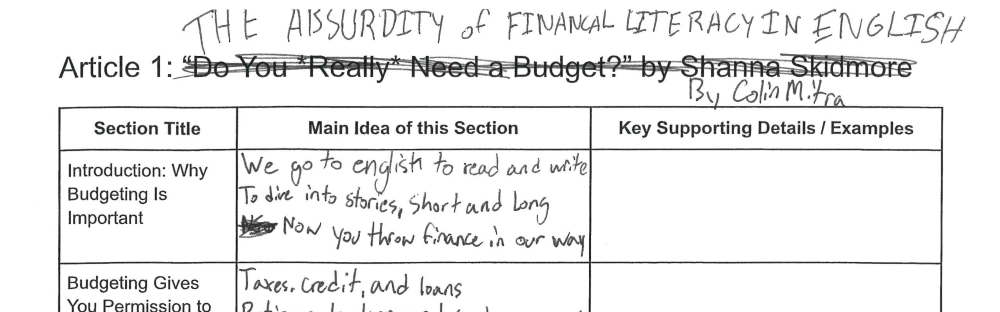
“I know you just work here,” said Colin, echoing what he’s heard me say jokingly, “and you didn’t plan this, but I’m not likely to be on board with assignments I’ve already done before.” 

I have to hand it to you, kid, I thought. You possess a talent for voicing your opinion with diplomacy that many adults lack. You have my attention.

“Lowkey, we learned the fifty/thirty/twenty method and made budgets in financial literacy class,” Myra said through her dreads.

“I’m assuming you also learned about credit in financial literacy?” I inquired. 

“Facts,” Myra fired back. “A lot about credit.” 

“And we created résumés in freshman success class,” Addy pleaded in a drawn-out drawl.

“Yeah, and I practiced interviewing at tech school,” added Aiden.

“Same,” became a refrain reverberating through the classroom.

It seemed all my seniors had previously practiced these financial and job-seeking skills. Granted, it may have been a couple of years, but still—they had my attention.

I had their attention, too. I acknowledged their frustration. Then, I paused, deep in thought.

There was a time when I prided myself on encouraging my students to use their voices. Fast forward a few years, and those voices washed out to sea, engulfed by the tests to which we teach. Suddenly, I stood surrounded by seniors protesting the plan for the final quarter of their last secondary school year. And it is national poetry month, after all. Visions of slam poetry danced in my head.

“I hear you, and I have an idea for an alternative assignment, but it involves poetry,” I proffered.

Aiden’s emerald eyes widened. Camron crossed his arms in front of his chest and cocked his curly-haired head to the side. 

“I’d rather write poetry,” Colin mused, nodding slightly.

Ivy’s brunette bob bounced. “Poetry?” she pondered. “Yeah, I vibe with that.”

A surprising number of them seemed excited about the prospect of expressive writing—even poetry. What emerged next warmed my teacher heart. I gave them the option to complete today’s assignment or write a protest poem in response to it. Then, toward the end of the class period, seventeen- and eighteen-year-olds lined up at my desk, asking me to read their poems. They had not been eager to have me read anything they’d written all year.

Perhaps my seniors will make an honest woman of me yet.

Rekindling My Lanterns

Originally, my blog began as a personal journey—an expressive writing endeavor much like Emily Dickinson described when she wrote: “I am out with lanterns, looking for myself.” However, my teacher self kept creeping in like the beautiful bougainvilleas that lined the cedar fence surrounding my childhood home in the tip of Texas. And, as I wrote expressively alongside my students, the lines between personal and professional writing continued to blur.

In 2022, after fifteen years at the same school, teaching the same subject at the same grade level, I bounced between different districts and sites annually for three consecutive years. This series of transitions proved to be a journey in and of itself.

During this time, I read and edited my dear friend’s doctoral dissertation, which examined the impact of the National Writing Project on a handful of teachers across the country. As I became engrossed in the best practices of these teachers, shame and longing began to bubble inside of me. Somewhere along the way from school to school—probably dating back to the onset of the pandemic in 2020—I lost sight of how to balance the growing test-driven mandates of PLCs with the community of writers I once cultivated in my classroom.

After that friend was officially dubbed “Doctor Durham,” she and I formed a writing group with a third friend and fellow Oklahoma Writing Project teacher consultant. As we began establishing a monthly routine of meeting, sharing, and discussing our writing, the absence of writing groups in my classroom caused more shame and longing to bubble up toward the surface. My students were missing out on these rich experiences.

The lack of expressive writing in my classroom left everything seeming, well, dark. Its absence had extinguished the spark of joy I used to find in my job. Now that I am settled once again, having found a site at which I intend to stay—and my husband is ever-so-grateful he won’t have to move the contents of my classroom a fourth time, which is more of an undertaking than one might imagine for this veteran teacher of eighteen years—I plan to experiment this last quarter of the 2024-2025 school year, weaving expressive writing into the curriculum like those tenacious bougainvilleas. The time has come to rekindle my lanterns.

When a teacher chooses to write instead of ‘eating her feelings’ …

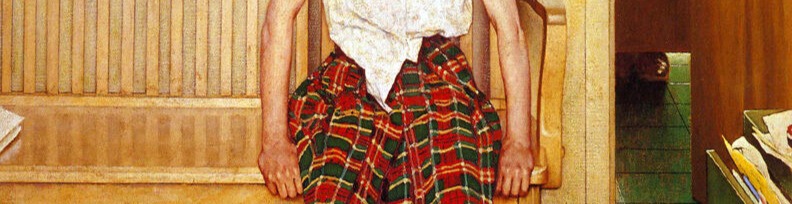
Today, I found myself waiting outside the principal’s office in tears for the second time in my life. The first time, I was in fourth grade. After finishing my classwork, I would talk to students around me. Regardless of where my teacher moved me, I seemed to have an insatiable appetite for talking to my peers. When my teacher’s patience waned, for which I cannot fault her, sweet Ms. Sebring sent me to the principal’s office. For some time, I stared at my plaid polyester uniform in anticipation. Fear and shame wrestled inside of me like two bloodthirsty beasts. I don’t know which was worse—Ms. Holy’s long, wooden paddle or the disapproving look etched on her face. I got swats, after which I never got in trouble at school again. That is how we rolled back then.

Flash forward nearly five decades. The difference extends far beyond the silver streaks in my brunette locks and the lack of plaid pleats. This time, I was not sent to the principal’s office—I fled to the principal’s office.

Early in my teaching career, children incapable of accepting accountability for their actions were the exception—not the rule—and their efforts were relatively benign, while their parents tended to be reasonably supportive. Within the last few years, however, the paradigm has shifted. As the number of students who struggle with owning their part began to rise, another phenomenon gained momentum—resorting to abusive tactics in an effort to avoid accountability at all costs. 

As a survivor of domestic violence, I recognize abusive tactics such as blame shifting, gaslighting, and harassing when I see them. In recent years, their foray into my professional life has been perplexing at best. For someone diagnosed with complex PTSD, they are downright triggering.

I worked hard to learn to overcome the effects of previous trauma, cope with triggers, and refuse to tolerate unacceptable behavior in my personal life. Rising up in resistance in the professional realm, however, is trickier to navigate. And the apples do not fall from the trees these days. Typically, when I encounter a child clinging to victimhood at all costs, a parent lurks in the shadows like a copperhead waiting to strike.

That was the case today. A young man refused to leave my classroom, refused to stop attempting to argue long after I quit participating in the conversation. No matter how many times I told him to leave, no matter how many times I told him to wait until we could conduct a conversation with an administrator and his mother present—as she requested (demanded?) in her emails this morning—he stood in my classroom during lunchtime, attempting to wear me down. He rationalized, justified, minimized, and flat out denied his behavior, all the while demanding that I explain myself. Ultimately, he called his mother and tried to force a conversation with her in the moment, claiming I told him to do so. I stared at the phone in his hand, envisioning the woman on the other end of the line. The woman who has made it clear she believes I am the problem—not her son. I felt harassed and outnumbered.

“I told you I am not doing this with you right now,” I said as I walked out of my classroom and headed toward the front office. When I reached the seat outside of the principals’ offices, I plopped down and felt the magnitude of the moment. Despite my best efforts, tears leaked down my freckled cheeks.

I wish I could say this was a one-time occurrence, that I had not experienced harassment at the hands of students and their parents previously. Sadly, this is the third school year I have encountered such bad behavior. 

It is age appropriate for children to struggle with accepting accountability. It is my job to facilitate this, and I have patience with students enduring this struggle—even eighth- and ninth-graders. But when parents perpetuate bad behavior and engage in it, my patience wanes. 

I spoke with three different principals today. Each one was compassionate, encouraging, and supportive. I know how fortunate I am. Nevertheless, today was one of those days that makes me question why I remain in education. Despite all of the challenges educators face, if I ever decide to leave the profession, it will be because of dysfunctional dynamics invading my workspace—the ripple effect of parents whose toxic tendencies trigger me.

Return to Learn Concerns

“One voice can change a room, and if one voice can change a room, then it can change a city, and if it can change a city, it can change a state, and if it change a state, it can change a nation, and if it can change a nation, it can change the world. Your voice can change the world.” ― Barak Obama

Dear Moore Public Schools Administrators and Board Members,

I teach English at Central Junior High School, where I display quotes such as the one above in my physical classroom and post them in my virtual learning environments. I encourage my students to use their voices and believe they can make a difference. I promote respect as our guiding principle, and I tell my students I will never ask them to do anything I have not done myself or would not be willing to do. If I am to continue these practices with my head held high, I must honor these ideals by voicing my concerns as respectfully as possible regarding our return to traditional learning in the classroom amid the COVID-19 pandemic.

Cases already have begun to spike as the result of schools reopening in states such as Indiana, Georgia, and Kansas (Shapiro, et al.), as well as Tennessee (Mangram) and more. The virus has arrived at our largest high school among custodians before we have even opened our doors. More and more school districts are deciding to delay the start of school, to begin the school year remotely, and/or to develop hybrid approaches and rotation schedules to decrease exposure (Shapiro, et al.). While the Moore Public Schools Return to Learn plan allows students and their families who are at increased risk due to underlying health conditions the option of remote learning, no such provisions exist for our district’s faculty and staff members who are at risk or have immediate family members at risk to continue being of service and maintain a viable income.

Undoubtedly, students need to be in school when schools can ensure a safe environment. We are far better equipped to meet students’ needs academically, emotionally, socially, and physically in a traditional classroom setting. But at what cost?

I want to be a team player. I want to do my part. I want to make a difference. But, I also want to preserve as many human lives as possible, and this is a life-and-death situation that is highly likely to result in negative consequences (Bendix) for students, faculty and staff members, the families of both, and, ultimately, the community at large.

This year, the notion that teachers work in the trenches seems truer than ever before. We are at far greater risk than administrators who continue to conduct meetings virtually and command their troops, so to speak, from behind the brick walls and plexiglass encasements of the Administrative Services Center.

Sound decisions are not made in fear, and I respect the fact that our district seems to embrace this truth. I write to you not in fear, but with valid concerns regarding the grave reality of the situation. I do not envy the task of the decisions you face, nor do I claim to have all of the answers. That said, as an educator and a parent, I implore you to reconsider our Return to Learn plan, ever mindful of the more than 26,500 human lives you hold in your hands.


Works Cited

Bendix, Aria. “Mounting research paints a bleak picture for schools trying to reopen. Most large schools can expect coronavirus cases within 1 week.” Business Insider, 4 Aug. 2020, www.businessinsider.com/should-schools-reopen-coronavirus-spread-us-2020-7.

Mangrum, Meghan. “These Tennessee school districts are already reporting COVID-19 cases after reopening.” Tennessean, 7 Aug. 2020, www.tennessean.com/story/news/education/2020/08/05/tennessee-school-districts-reported-coronavirus-cases/3296529001/.

Shapiro, Eliza, et al. “A School Reopens, and the Coronavirus Creeps In.” The New York Times, 1 Aug. 2020, www.nytimes.com/2020/08/01/us/schools-reopening-indiana-coronavirus.html.

Remembering Trey

While the world waxes poetic about the difference teachers make in the lives of students, the impact of young souls upon us is seldom spoken. Many students have made their way into my heart over the years, playing a part in molding me into the woman I am today, teaching me compassion and tolerance amid the need for upholding consequences, modeling good behavior, and apologizing when I fall short myself, as all humans do. But one in particular nestled up inside my heart and etched himself inside my mind so deeply he moved me to write about him way back when.

Today, I find myself trying to make sense of the senseless—the news that his life was taken last night. The heart of the boy with the big dimples beats no more, but his memory beats on in the hearts of many, and I am blessed to be one whose life he touched.

When I am seized with grief, my self-care includes creation. So, I created this post to capture what Trey Mitcheltree meant to me, and to illustrate how immensely one young life can impact an educator.


Navigating Trey: A Teacher’s Voyage

by L. Alicia Lacy-Scott (formerly Monroe) | 2008

I seize the chair as if it is the helm and I am about to sail into the depths of his fourteen-year-old soul. “What’s going on?” I inquire, peering into his deep sea eyes.

“I don’t know. I’ve been getting into trouble in all of my classes.” He glances down at his hands which he clasps and lays in the blue jeans fold of his lap. The short midnight hair on the crown of his head blends in with his dark Metallica T-shirt. I foresee our conversation devouring more and more of the thirty minutes allotted for lunch.

Silence surrounds us—a stark contrast from the sounds of students that filled the room during fourth hour. Now, as his classmates clamor into the cafeteria, I sit with Trey in silence. I never knew he could be this quiet. He crashes wave after wave of sarcasm against the shore, drenching others with the sting of cold salt water, mocking them with the wind. Thirty minutes ago, he sent Shelby to the counselor’s office in tears.

“You don’t know when to stop, Trey. You are so bright and so funny, but there is a fine line between wit and sarcasm, and when you aren’t careful, you cross that line. You crossed it today.”

“Shelby is too emotional,” he counters.

“Shelby is very emotional. Many girls your age are. Some of us are much better at controlling our emotions than others,” I reply. “But what you said was uncalled for. I understand you were trying to be funny, but you took it too far.”

“She’s weak. I hate people like that.”

“Trey,” I say softly, waiting for his eyes to meet mine, “I am one of those people.” His eyes search mine, then focus on the fluorescent lights marching across the ceiling. Tears spray his cheeks as he speaks of living in his brother’s shadow, of never measuring up, and of fear. This boy before me feels nothing he does is good enough. This boy before me—a black belt—fears he will go to jail for a fight even though he refused to fight back. If the punk who jumped him gets off, Trey reasons, the judge will assume his accusations are lies and lock him away for perjury. This boy before me thinks he has become the very thing he despises—weak and emotional—because he is unraveling before my eyes. Unraveling like a rope bleached by the sun, weathered by the sea.

“Trey, you are not weak,” I reassure him. “You are human. We all need someone to talk to, someone who will listen without judgment, sometime.”

“I guess you’re that ‘someone,’” he mumbles, his dimples emerging as he dries the tail-end of his tears. “Thank you,” he whispers. The bell rings.

For thirty minutes I have been lost with this boy at sea, helping him navigate his way toward land. Thirty exhausting minutes. Thirty minutes I would not trade for anything. Thirty minutes to remind me why I am here. Why I chose to be here. Why there is no place I would rather be.

Reflections on writing “Navigating Trey: A Teacher’s Voyage”

I began this piece at an OWP writing marathon in March 2008. A sculpture at the Oklahoma Art Museum titled “Man With Child” reminded me of a story I’d been meaning to get down on paper but had not yet found the time to do so. I scribbled it in my journal and tucked it away until the summer institute rolled around. Hoping to use this piece as a vignette in my thesis, I typed it and posted it on the E-Anthology.

After revising based on suggestions from people scattered across the continent, I learned of N. Scott Momaday’s three-voice narrative poems during Freeda Richardson’s presentation, “What Unites Us: The Power of Story in Native American and World Poetry.” I decided to turn this vignette into the story or first voice of a three-voice narrative illustrating the impact of teachers listening to their students. I added a second voice reflecting personally on the story and a third voice reporting my findings.

I also entered “Navigating Trey” in the OWP writing contest in January 2009, and it won the teacher prose competition. It is published in Literary Leaves, the 2009 Writing Conference Anthology, and in my thesis, which I defended May 2009.

Fund Their Future

I followed the painted paw prints down the hallway of Central Junior High School for the first time in 2007 when I launched my career as a teacher of English language arts. I knew not the challenges I would face as an educator; I knew only how excited I was as a former writer and editor to share my love of literacy with the young adolescents who would filter in and out of my classroom each day, in and out of my life each year. The only thing better than passing along my passion for the pen was how privileged I considered myself to be blessed with the possibility of making a difference in young lives.

Blessed indeed. Blessed to watch them blossom as readers and writers. Blessed to promote positivity and extend encouragement. Blessed to cultivate them and congratulate them, to console them and to cry with them. And, yes, even blessed to place calls to DHS on their behalf, because I was the adult some felt safe turning to with situations no child would ever encounter in an ideal world.

But this world is not ideal. And the vigor with which I approach the job I have come to view as a ministry has diminished over the years as have the conditions under which I teach. Building relationships with students, the hallmark of good teaching, becomes increasingly difficult in direct proportion to the rising number of students who filter in and out of my classroom each day, in and out of my life each year.

Never mind the troublesome task of making ends meet as the single mother of three on an Oklahoma educator’s salary who has not received a single raise during her 10-year teaching career. Never mind the books and snacks and other miscellaneous supplies I have purchased out of my own pocket despite being underpaid and underappreciated. Never mind how many extra hours I put in, regularly working alongside our evening crew of custodial staff, which has been slashed due to budget cuts while continuing to clean up after our growing body of students. Never mind the steady stream of ever-changing state standards as well as testing formats and rubrics that liken the delivery of instruction and preparation for state testing to an archery contest at which we aim arrows and send them spiraling toward moving targets year after year. Never mind the sliding scale of testing scores, which has been altered after tests were administered and results reported to prevent too many of Oklahoma’s finest from passing with a score of proficient. Never mind our governor’s rude remarks portraying me as lazy and greedy and ungrateful, comparing me to a teenager who sulks in attempt to secure a better car because I expect no less for my children, my students, and myself than the value and loyalty she demonstrates for her cabinet members, such as the significant pay raise she approved and strings she pulled for Preston Doerflinger, Secretary of Finance, despite his blatant disregard for the law, not to mention my profession.

Mind this … Oklahoma children deserve better. They deserve the best resources – technology and textbooks and teachers. Instead, they filter through hallways alongside painted paw prints and in and out of classrooms that are overcrowded and underfunded. They find themselves over-tested and undervalued. Send the message to Oklahoma’s most precious commodity that they are worth it. Fund their future.

Going Home

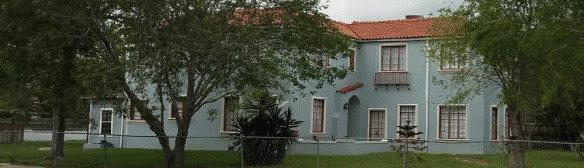
The magnificent mansion greets me like a guardian I have outgrown, now bearing a blue tint—a hint of sadness, it seems. Bright bougainvilleas no longer line the property. My favorite palm tree no longer perches beside the patio where I played as a child, pretending to be somewhere else, someone else—anywhere but here, anyone but me. But, if I listen carefully, it calls to me, serenading with a song of sorrow, but also, of recovery. Perhaps it sang this song all along, hoping I might hear harmony, even if only as an echo in decades to follow.

If these walls could talk, would they whisper words of wisdom? Lament losses of a family it cradled amid catastrophe? Tell traumatic tales of a tribe that did its best, but battered itself, nonetheless? The formidable fortress fought the good fight against forces of nature, after all, withstanding the likes of Hurricane Dolly. I wonder whether its walls were wounded by the wars waged within.

I am listening, old friend. You carry scars, too, but they do not define you. You still stand tall. You still serve to shelter and seek to soothe the precious people dwelling inside of you, just as I do for the little girl hiding inside of me. The little girl who became someone else, somewhere else and, after all this time, has journeyed back to put to rest the troubles of that family that did its best.

Like you, I have weathered many storms along the way, but I am still standing tall, scars and all; and I am stronger for it.

Like you, I have seen people come and go. Some I do not miss, though I cherish the lessons they taught me along the way. Some I cling to the memory of every day. Some stand beside me knowing, though I don a confident and competent face, occasionally I must embrace that little girl I have learned to listen to and love. Like the Gulf of Mexico, some ebb and flow. But this you should know …

Walls cannot speak of things people refuse to recognize. So, no need to apologize. I realize you did your best, too. The shelter you provided saw me through. And that, old friend, is enough.

My Name, Like the Hurricane

It never snowed where I grew up. Well, it did once back in the early 1900s, long before I was on the scene. Snow was a bad word in the Rio Grande Valley. Freeze was enemy to the farmer who feared for row after endless row of citrus trees. Snow meant starvation.

So we never had a snow day at school. We set out school-bound every morning, 180 days a year. There was one thing that got us out of class. Her name was Alicia, just like mine, and she was a whirling dervish of water that worked her way inland and wreaked havoc. My mother packed me, my sister, and her Bernina in the back seat of her 1978 Cordoba. No building snowmen, no hurling snowballs at each other. No sledding or snow angels. Just hour after hour in the back seat of the car—me, my sister, and the sewing machine. We raced down the road out of harm’s way, away from the hurricane that shared my name. We sought shelter at the Four Seasons Hotel. White towels, white sheets, and little white soaps in a place that implied a time for snow.

We lived in a white stucco house. We drove a white car. We had a white German shepherd. My mother sewed our dresses on a white sewing machine. We were white. Blanca. Bolias. Gringas. And me with the Spanish name. They called me Alice. They did so with affection, and embraced me in their culture; yet I longed desperately to share their Hispanic heritage. To be one of them.

My sister’s name is Cimarron. They would say it with a Spanish accent, but it is an Indian name. She with her blond hair that they loved to touch, and me, the part Sioux, part Choctaw, but mostly white gringa with the Spanish name.

I was named after Alicia Lopez, the flying trapeze artist who befriended my mother as we traveled the continent with the Shrine Circus. My father was half-owner and ringmaster. I turned six months old in Mexico City where it never snows and they call me Alice. I celebrated my first birthday in Montreal shortly after my trapeze-flying namesake taught me to walk—on the ground.

I slept in a makeshift crib in the car as we drove from location to location. I still get sleepy when I ride in the car for long stints, like I did on our way home from the Four Seasons Hotel after the hurricane that shared my name died down.

We moved back to Oklahoma when I was in high school, and no one called me Alice again. But they do not pronounce my Spanish name properly. In Spanish, you say each syllable. Uh-lee-see-uh. Here in Indian territory, where they know my sister’s name, they call me Uh-lee-shuh. Here where it snows in the cold season. Here where we occasionally have enough snowfall for snowmen and snow angels and snow days. Here where we hurl snow balls at each other, and they say, “Heads up, Uh-lee-shuh!”

Alicia is my middle name. When I write my name, I precede Alicia with a lonely L, which stands for LeeAnne. Who can’t pronounce LeeAnne? Who would hesitate calling a freckle-faced gringa LeeAnne? LeeAnne who likes snow and doesn’t look like an Indian. LeeAnne who no longer writes a lonely L at the beginning of her name.

Dear Younger Me

Dear Younger Me,

Your love of language will intrigue you, entertain you, and, at times, sustain you. It will lead you down two career paths—first, as a journalist; second, as an English teacher. The words of others will bring you to your knees and help you stand tall—from Matthew, Mark, Luke and John to William Paul Young; from Mary Oliver to Robert Frost; from Jane Austin and Kate Chopin to Stan Lee and J.R.R. Tolkien. Furthermore, your own words will heal you in ways you never imagined.

One of the greatest lessons you will learn is echoed in Aragorn’s exclamation to Frodo and his fellow Hobbits near the end of The Return of the King: “My friends, you bow to no man.” You will spend years bowing to men. It will ensure your survival while you are young, and it will prove perhaps your biggest challenge in life to overcome.

Rest assured, you will overcome it, sweet girl. You will realize and ultimately internalize some simple truths. You have far more courage than you ever imagined. You need bow to nothing of this world—only to your Maker, who loves you unconditionally in ways you cannot fathom, and who is always by your side.

You are not responsible for the suffering you endured as a child. You are, however, responsible for the suffering you will seek out obliviously as an adult, because it is familiar. What’s more, you will continue to put yourself through it until you finally understand your own worth and consciously decide daily to follow God’s will and treat yourself as the treasure you are. All of this is a process, and God will place people in your path along the way who will prove instrumental in your journey.

These people, little one, are the most important part. Some will be a positive force in your life, and some will be negative; but, they all present opportunities for growth. Therefore, they all offer reasons to be thankful. Love them all. Set boundaries to protect yourself as necessary, and spend time with those who treat you with respect. But, love every one of them the way God loves you, and your heart and soul will soar all the more for it.

Forgive, let go, live for the moment, be grateful, and be of service to others. For gratitude is an attitude all who are willing can embrace, no matter their circumstances. And, a grateful heart is a happy, humble heart. Moreover, being of service to others is why we are here, whether it’s taking care of family, lending a helping hand to friends, providing a safe place for students, or volunteering locally or in a third world country.

When we find ways to seek God’s will and be of service with a happy, humble heart … that is when we truly live. And you, beautiful child, were born to live!

All my love,
Older Me