So, I lied. I made the declaration with the best of intentions, but I failed to follow through. After feeling inspired by an evening with my writing group, grand plans of expressive writing led me to compose my previous blog post, Rekindling My Lanterns. Even if all I could squeeze in was a daily quick write, I was determined to revive low-stakes, personally meaningful writing—and sharing—in my classroom. I followed through with four freshman classes for two days. Then, Romeo and Juliet essays, common summative assessments worth a hefty chunk of their overall grades, took over our time from bell to bell.
Both of my senior classes were in the midst of response-to-literature projects after reading All the Light We Cannot See, so there was no time to spare there. After finishing our projects, we launched into the first of several real-world activities waiting for us in the last quarter—creating a budget, which would be followed by learning about credit, writing résumés, and conducting practice interviews.
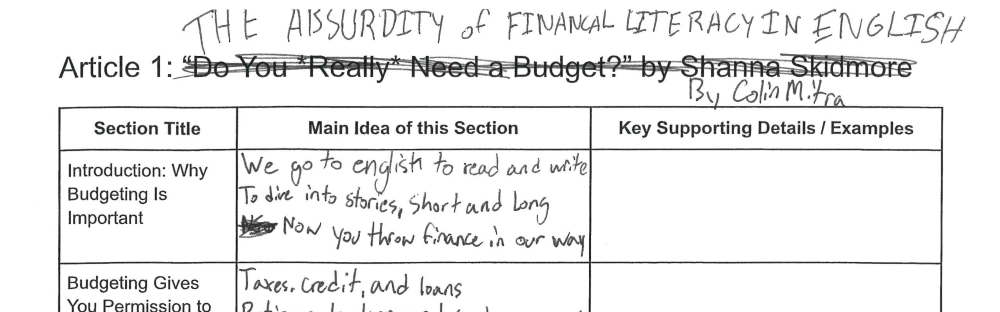
“I know you just work here,” said Colin, echoing what he’s heard me say jokingly, “and you didn’t plan this, but I’m not likely to be on board with assignments I’ve already done before.”
I have to hand it to you, kid, I thought. You possess a talent for voicing your opinion with diplomacy that many adults lack. You have my attention.
“Lowkey, we learned the fifty/thirty/twenty method and made budgets in financial literacy class,” Myra said through her dreads.
“I’m assuming you also learned about credit in financial literacy?” I inquired.
“Facts,” Myra fired back. “A lot about credit.”
“And we created résumés in freshman success class,” Addy pleaded in a drawn-out drawl.
“Yeah, and I practiced interviewing at tech school,” added Aiden.
“Same,” became a refrain reverberating through the classroom.
It seemed all my seniors had previously practiced these financial and job-seeking skills. Granted, it may have been a couple of years, but still—they had my attention.
I had their attention, too. I acknowledged their frustration. Then, I paused, deep in thought.
There was a time when I prided myself on encouraging my students to use their voices. Fast forward a few years, and those voices washed out to sea, engulfed by the tests to which we teach. Suddenly, I stood surrounded by seniors protesting the plan for the final quarter of their last secondary school year. And it is national poetry month, after all. Visions of slam poetry danced in my head.
“I hear you, and I have an idea for an alternative assignment, but it involves poetry,” I proffered.
Aiden’s emerald eyes widened. Camron crossed his arms in front of his chest and cocked his curly-haired head to the side.
“I’d rather write poetry,” Colin mused, nodding slightly.
Ivy’s brunette bob bounced. “Poetry?” she pondered. “Yeah, I vibe with that.”
A surprising number of them seemed excited about the prospect of expressive writing—even poetry. What emerged next warmed my teacher heart. I gave them the option to complete today’s assignment or write a protest poem in response to it. Then, toward the end of the class period, seventeen- and eighteen-year-olds lined up at my desk, asking me to read their poems. They had not been eager to have me read anything they’d written all year.
Perhaps my seniors will make an honest woman of me yet.
 Out With Lanterns